
Driving the Future: Why Zero-Emission Transit Requires Systems Engineering?


Going electric is no longer a vehicle-purchase decision. It reshapes facilities, grids, schedules, data, and the workforce, and it succeeds or fails on how well those pieces are engineered to work as one.
Executive Takeaway: Zero-emission transit succeeds when fleet planning, infrastructure, enterprise systems, utility coordination, procurement, training, and lifecycle risk management are connected from the start.
Transportation agencies across the United States are approaching zero-emission transit with a much broader perspective than they did just a few years ago. What initially began as a localized sustainability initiative, primarily focused on tailpipe emissions reductions and vehicle replacement cycles, has rapidly evolved into an expansive, multi-disciplinary infrastructure conversation.
Today, this shift impacts virtually every aspect of transit planning, daily operations, and long-term capital program delivery.
Federal funding priorities, state-level environmental mandates, and forward-looking regional mobility strategies are accelerating the transition toward Battery Electric Buses (BEBs) and Hydrogen Fuel Cell Electric Buses (FCEBs). At the same time, agencies are discovering that adopting zero-emission operations involves far more than selecting new vehicles or meeting regulatory compliance deadlines.
To scale these programs successfully, transit leaders are moving away from traditional siloed procurement models. Decisions around charging infrastructure, utility coordination, maintenance workflows, route scheduling, and asset management are merging into a singular planning ecosystem.

1. Why Agencies Are Rethinking Zero-Emission Strategy?
The fundamental driver behind the shift toward zero-emission transit is a combination of environmental policy, historic capital funding opportunities, and operational necessity. Because the transportation sector remains one of the largest contributors to greenhouse gas emissions in the United States, public transit agencies find themselves at the center of regional sustainability conversations.
Historically, buying a new bus was straightforward: an agency specified diesel or compressed natural gas (CNG) models, accepted delivery, parked them in a standard lot, and fueled them at existing depot pumps. Electric and hydrogen options break this isolated procurement loop. Because zero-emission vehicle performance is directly tied to complex on-site fueling and charging infrastructure, fleet decisions immediately impact electrical capacity, civil engineering layouts, software governance, and workforce readiness.
To prevent these capital investments from disrupting existing services, progressive agencies utilize a structured systems engineering approach. This framework connects abstract technical requirements and fixed operational constraints to implementation sequencing early in the lifecycle.
NITI SYSTEMS CAPABILITY: SYSTEMS ENGINEERING
Our team is fully certified and trained in the FTA-approved Systems Engineering lifecycle. We help agencies bridge the gap between abstract planning and concrete field deployment, turning early concepts into technically sound, buildable requirements that survive contact with real operations.
2. Breaking Down the Fleet Ecosystem
One of the most significant insights emerging within transit leadership is that zero-emission technologies fundamentally change the entire operating environment surrounding the fleet. The introduction of battery or fuel cell technology triggers a cascade of operational changes across multiple departments.

Department | Operational Impact & Focus | Niti Systems Core Capability |
Facilities & Engineering | High-voltage upgrades, yard layouts, automated fire suppression, catenary clearances. | Feasibility, alternatives analysis, and capital planning layout coordination. |
Scheduling & Dispatch | Ambient temperature route modeling, fixed charging windows, emergency rerouting. | Run-cutting modeling and block scheduling optimization. |
Workforce & Maintenance | High-voltage safety protocols, rooftop component diagnostic proficiency. | PROSCI-certified training plans and skill development pipelines. |
Utility & Energy | Substation capacity, demand-charge reduction, microgrid and solar storage integration. | Smart grid strategy and energy asset lifecycle architecture. |
Infrastructure Grid Integration & Facility Overhauls
Traditional transit facilities are rarely built to draw megawatts of continuous power from the commercial grid. Upgrading a facility to support dozens of fast-charging systems requires extensive civil and electrical engineering. Agencies must establish close partnerships with regional utility providers years in advance to assess substation capacities, map local distribution lines, and negotiate industrial energy rates.
Route Modeling & Scheduling Realities
Unlike diesel or CNG buses, which maintain consistent operating ranges regardless of weather or passenger loads, electric buses face real-world efficiency challenges. Extreme winter sub-zero temperatures or intense summer heat waves put heavy demands on HVAC systems, which can reduce battery range by 30% to 40%. To protect service reliability, planning teams use advanced route modeling software to simulate these variables, ensuring operators are never dispatched on blocks that exceed the real-time charge of their vehicles.
Workforce Readiness & Maintenance Workflows
The shift to zero-emission fleets demands an entirely new technical skillset from maintenance crews. Working with high-voltage battery arrays, complex inverters, and hydrogen fuel cells requires sophisticated technical safety protocols. Maintenance shops require extensive layout modifications, including specialized overhead safety fall-protection harnesses and non-conductive tooling, since many electric and hydrogen components are housed on the roof of the bus.
NITI SYSTEMS CAPABILITY: CHANGE MANAGEMENT
Technology is only as good as the team operating it. Anchored in the renowned PROSCI ADKAR framework, our certified change managers work alongside your teams to transform internal business processes, build technical competencies, and deliver custom training curriculums across the entire project lifecycle.
3. The Enterprise Data Layer
As zero-emission fleets move from small-scale pilots into full revenue service, managing data becomes just as important as managing physical infrastructure. Modern zero-emission transit platforms generate massive amounts of continuous data. Every vehicle transmits real-time state-of-charge (SoC) metrics, battery temperature profiles, and regenerative braking performance over cell networks.
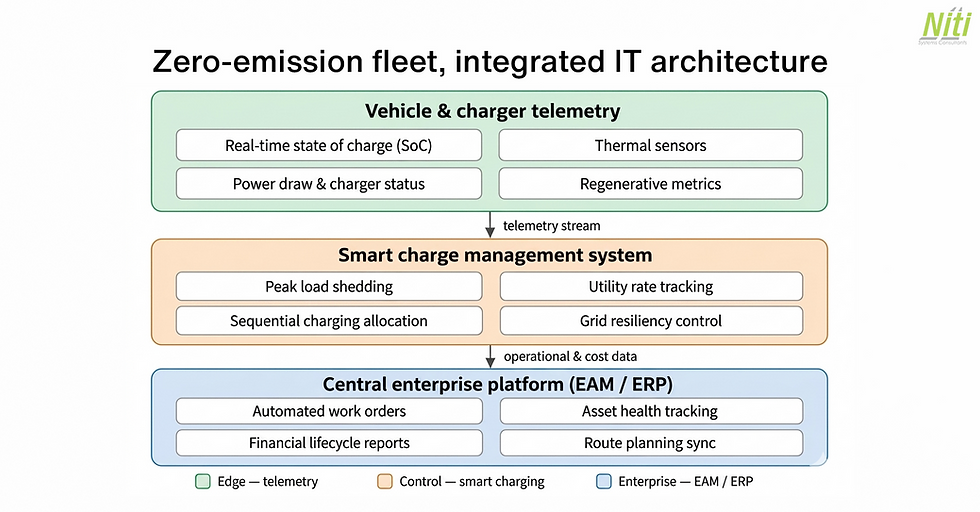
When telemetry, charge management, and Enterprise Asset Management (EAM) / dispatch are fully integrated, several high-value operational capabilities are unlocked:
Automated Work Orders
If a vehicle's battery pack records an unusual thermal signature during revenue service, the telemetry feed triggers an immediate alert and schedules a diagnostic check within the EAM platform before the bus returns to the yard.
Sequential Smart Charging
Rather than plugging in every bus at 8:00 PM and triggering massive peak-demand utility surcharges, a smart charge management platform sequences charging automatically based on scheduled morning rollout times and real-time electricity pricing.
Predictive Health Analytics
Over time, aggregate data allows engineering teams to accurately track cell degradation rates, evaluate the long-term lifecycle performance of different battery manufacturers, and make data-driven decisions for future capital procurements.
NITI SYSTEMS CAPABILITY: ENTERPRISE TECHNOLOGY
Our technical team includes certified technology architects and systems integration experts who specialize in Enterprise Technology Solutions. We break down data silos by seamlessly connecting physical shop-floor assets (chargers and vehicles) with top-floor enterprise systems like ERP, EAM, and data warehouses, ensuring a single source of truth for your operations.
4. Engineering a Phased Framework
Because public transit systems operate on fixed schedules and fulfill strict community service mandates, agencies cannot halt daily operations while installing new infrastructure. Managing a zero-emission rollout requires a phased implementation framework that keeps existing routes running smoothly.

1. Operational Analysis & Base Modeling
Conduct thorough route simulations, terrain mapping, and seasonal weather evaluations to establish a clear operational baseline before hardware is selected.
2. Infrastructure Design & Utility Coordination
Engage regional utility providers to secure required power capacity and design facility electrical layouts with modular, scalable footprints.
3. Pilot Deployment & Rigorous Testing
Introduce a limited footprint of zero-emission buses into revenue service to validate real-world range data against theoretical models.
4. Systems Integration & OCM Upskilling
Connect vehicle telemetry directly to central EAM software and roll out advanced mechanical training courses.
5. Phased Scaling & Asset Management
Gradually decommission older fleets as charging infrastructure scales up, integrating data into the Transportation Asset Management Plan (TAMP) to optimize long-term costs.
5. Navigating Interdependency and Lifecycle Risks
As zero-emission programs mature past the early adoption phase, transit agencies encounter new risks rooted in technical interdependency.
The Interdependency Challenge
If a traditional diesel fueling pump breaks down, an agency can resolve the issue within hours, utilize alternative backup pumps, or temporarily fuel vehicles off-site. However, if an electric depot experiences a major network failure, a smart charging software glitch, or a localized utility grid outage, the entire fleet can be grounded simultaneously.
To protect operations against single points of failure, resilience must be designed into the ecosystem.

Diverse Power Solutions
Integrating on-site battery energy storage systems (BESS), solar arrays, and emergency backup generation provides a buffer against unexpected grid disruptions.
Interoperable Standards
Requiring open, non-proprietary communication frameworks, such as the Open Charge Point Protocol (OCPP), prevents agencies from getting locked into single-vendor ecosystems.
Resilient Communications
Designing fallback localized software networks ensures that chargers continue dispensing power safely even if connection to the cloud is temporarily lost.
By identifying and addressing these infrastructure vulnerabilities early, agencies transition from a reactive posture to a proactive, resilient operational model.
Conclusion: Partnering for Long-Term Scale
The future of public transportation across the United States is undeniably zero-emission, but reaching that goal requires looking beyond the vehicles themselves. True modernization does not happen at the tailpipe; it is built on invisible architecture, the electrical grids, systems engineering frameworks, integrated data streams, and workforce training programs that keep fleets moving safely every single day.
By treating the zero-emission transition as an agency-wide operational transformation rather than a basic vehicle replacement project, transit organizations can navigate infrastructure risks, manage capital budgets wisely, and build a resilient mobility ecosystem that serves their communities for generations to come.
How Niti Systems Can Help?
Niti Systems supports zero-emission and transportation technology programs through five connected service areas:
Transit Systems Consulting
ITS, fare collection, CAD/AVL, asset management, control centers, systems engineering, and lifecycle implementation.
Mobility Services
Multi-modal integration, Mobility as a Service, zero-emission transition planning, and enterprise asset management.
Enterprise Technology Solutions
ERP, CRM, EAM, data platforms, integration architecture, dashboards, and governance.
Professional Services
Program management, change management, communications, training, staff augmentation, and contract support.
Engineering Services
Civil, electrical, rail, mechanical, power systems, safety, QA, and infrastructure readiness support.


Comments